Scimitar syndrome with horseshoe kidney and portal vein thrombosis
Written and reviewed by RadLearn editorial team · Updated 20 Oct 2026
Figures (9)
Patient history
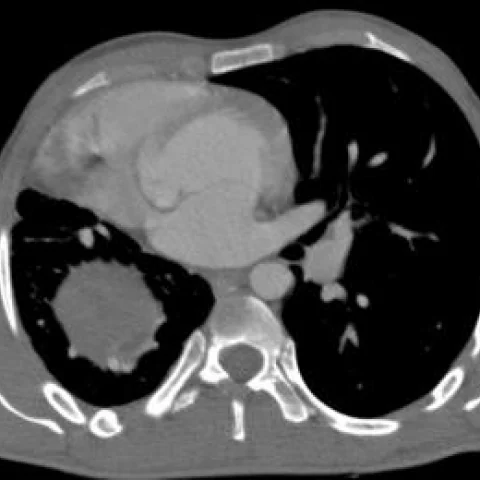
A 17-year-old man with a two-year history of right-sided chest pain and mild shortness of breath. Clinical examination found reduced breath sounds over the right hemithorax.
Imaging findings — key points
- Axial and coronal contrast-enhanced CT shows a large anomalous pulmonary vein draining the right lung into the inferior vena cava below the diaphragm, producing a scimitar-shaped curvilinear opacity.
- The right lung is hypoplastic with reduced volume and abnormal bronchial branching, and the heart is dextroposed with the mediastinum shifted to the right.
- There is an arterial supply to the right lower lobe from the descending aorta, and the right pulmonary artery is small.
- Multiplanar reformats demonstrate a horseshoe kidney with fusion of the lower poles across the midline, and thrombosis of the portal vein with cavernous transformation.
- No pulmonary arteriovenous malformation or bronchial obstruction is identified.
Discussion
Scimitar syndrome is a congenital cardiopulmonary anomaly characterised by partial anomalous pulmonary venous return of the right lung to the inferior vena cava, right lung hypoplasia, dextrocardia and often a systemic arterial supply to the right lower lobe. The anomalous vein produces a curved, scimitar-like shadow on the chest radiograph, and CT or MRI defines the venous anatomy, the degree of shunting and associated anomalies such as a horseshoe kidney. Patients may be asymptomatic or present with recurrent right-sided infection, exertional dyspnoea or heart failure from a left-to-right shunt. Surgical or transcatheter correction is indicated for significant shunting or recurrent pulmonary infection.
Differential diagnosis
| Alternative diagnosis | Key features that distinguish it from this case |
|---|---|
| Meandering pulmonary vein | A meandering pulmonary vein is an anomalous course of a normally connecting vein and is not associated with right lung hypoplasia, dextrocardia or a systemic arterial supply. |
| Swyer-James syndrome | Swyer-James syndrome produces a hyperlucent, small lung after childhood bronchiolitis with air trapping and a normal pulmonary venous connection. |
| Pulmonary arteriovenous malformation | An arteriovenous malformation shows a direct artery-to-vein shunt with a nidus and early venous filling, without anomalous drainage to the inferior vena cava. |
| Hypogenetic lung syndrome without scimitar vein | Right lung hypoplasia can occur without anomalous venous return, but the defining feature here is the scimitar vein draining to the inferior vena cava. |
The confirmed diagnosis itself is not included as an alternative — it is stated separately below.