Pulmonary fibrosis due to paraquat poisoning
Written and reviewed by RadLearn editorial team · Updated 20 Oct 2026
Figures (5)
Patient history
A 31-year-old man with alcohol misuse was brought to the emergency department four hours after ingesting herbicide in a suicide attempt. Gastrointestinal decontamination and haemodialysis were performed immediately and the patient survived. He was discharged two months later. One year on, he became progressively more breathless.
Imaging findings — key points
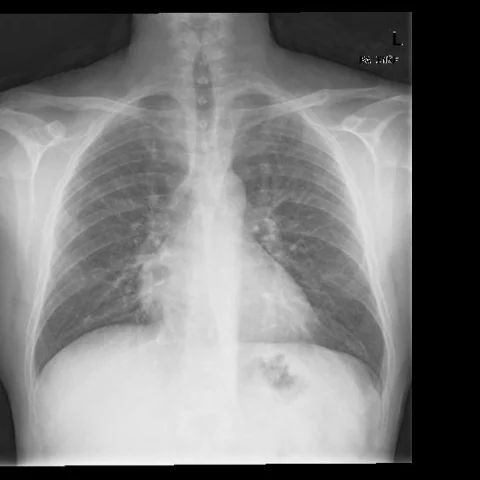
- The initial radiograph after paraquat ingestion shows ill-defined airspace opacification in both mid and lower zones, which progresses on the follow-up radiograph despite decontamination.
- HRCT one year later demonstrates bilateral subpleural reticulation with architectural distortion and traction bronchiectasis, predominantly in the lower lobes.
- There is volume loss with elevation of the hemidiaphragms and crowding of the bronchovascular structures, and honeycombing is present in the subpleural regions.
- No significant ground-glass opacity, consolidation, pleural effusion or lymphadenopathy is identified at follow-up.
- The combination of a clear exposure history and a basal, subpleural fibrotic pattern distinguishes this from idiopathic pulmonary fibrosis.
Discussion
Paraquat is a highly toxic herbicide that produces dose-dependent injury through generation of reactive oxygen species, with the lung being the principal target because of active uptake by alveolar epithelial cells. Severe poisoning causes early acute respiratory distress syndrome and, in survivors, progressive pulmonary fibrosis that becomes apparent weeks to months later. HRCT shows a usual interstitial pneumonia-like pattern with subpleural reticulation, traction bronchiectasis and honeycombing, and the extent of fibrosis correlates with long-term respiratory disability. There is no specific antidote, so management is supportive, and the prognosis of established fibrosis is poor.
Differential diagnosis
| Alternative diagnosis | Key features that distinguish it from this case |
|---|---|
| Idiopathic pulmonary fibrosis | IPF produces an identical usual interstitial pneumonia pattern but occurs in older patients without a toxic exposure and progresses inexorably, whereas this fibrosis has a defined herbicide trigger. |
| Drug-related pulmonary fibrosis | Drug-induced fibrosis follows chemotherapy or other agents such as amiodarone and improves or stabilises after withdrawal, and the exposure history differs from paraquat poisoning. |
| Nonspecific interstitial pneumonia | NSIP shows more uniform ground-glass opacity and less honeycombing than usual interstitial pneumonia, and it is not associated with a single acute toxic ingestion. |
| Organising pneumonia | Organising pneumonia shows patchy consolidation and reverse halo signs and responds to steroids, without the progressive honeycombing seen after paraquat. |
The confirmed diagnosis itself is not included as an alternative — it is stated separately below.