Madelung disease type I
Written and reviewed by RadLearn editorial team · Updated 20 Oct 2026
Figures (12)
Patient history
A 66-year-old man presented with symmetrical swelling involving the shoulder girdle, neck and face. He had a history of moderate alcohol intake. A paratracheal lipoma had been resected years earlier because of dyspnoea. There was no other relevant history.
Imaging findings — key points
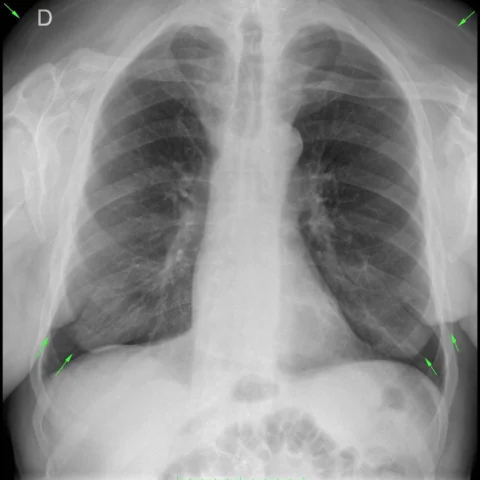
- The AP chest radiograph shows widening of the superior mediastinum and soft-tissue fullness of the neck and shoulder girdle, with preserved lung parenchyma.
- CT demonstrates massive, symmetrical, non-encapsulated fat-density tissue with attenuation between -80 and -120 HU involving the neck, supraclavicular regions, shoulder girdle, paraspinal muscles and superior mediastinum.
- The fatty proliferation displaces rather than invades the trachea, oesophagus and great vessels, and there is no enhancement or calcification within it.
- 3D volume-rendered reconstructions show the extent of the lipomatous mass around the shoulder girdle and its continuity with the mediastinal fat.
- MRI confirms that the mass follows fat signal on T1- and T2-weighted images and suppresses on fat-saturated sequences, with thin internal septa and no solid component.
Discussion
Madelung disease, also called benign symmetric lipomatosis, is a rare disorder of unknown cause characterised by massive, symmetric, unencapsulated fat deposition in the head, neck, shoulder girdle and mediastinum, and it is strongly associated with chronic alcohol use and Mediterranean ancestry. Type I disease involves the neck and shoulder girdle in a collar-like distribution, whereas type II is more diffuse and resembles simple obesity. The fatty masses may compress the airway, oesophagus or great vessels and can cause dyspnoea or dysphagia, which is the main indication for surgery, and recurrence after incomplete excision is common. Imaging is diagnostic when unencapsulated fat with characteristic distribution is seen, and it also documents airway compromise before surgery.
Differential diagnosis
| Alternative diagnosis | Key features that distinguish it from this case |
|---|---|
| Obesity | Obesity produces generalised fat deposition that follows the normal body contour and is not confined to the neck, shoulder girdle and mediastinum in a symmetric, mass-like fashion. |
| Bannayan-Zonana syndrome | Bannayan-Zonana syndrome causes multiple discrete lipomas together with macrocephaly, developmental delay and pigmented macules of the penis, rather than diffuse unencapsulated cervical fat. |
| Cowden syndrome | Cowden syndrome is characterised by hamartomas of the skin, breast, thyroid and brain with an increased risk of malignancy, and does not produce a symmetric mediastinal and cervical fatty mass. |
| Drug-induced lipomatosis | Steroid or antiretroviral therapy produces a buffalo hump and centripetal fat accumulation with a characteristic drug history, and the fat distribution is usually less extensive and symmetric than in Madelung disease. |
The confirmed diagnosis itself is not included as an alternative — it is stated separately below.