Kaposi sarcoma with skin and muscle involvement
Written and reviewed by RadLearn editorial team · Updated 20 Oct 2026
Figures (6)
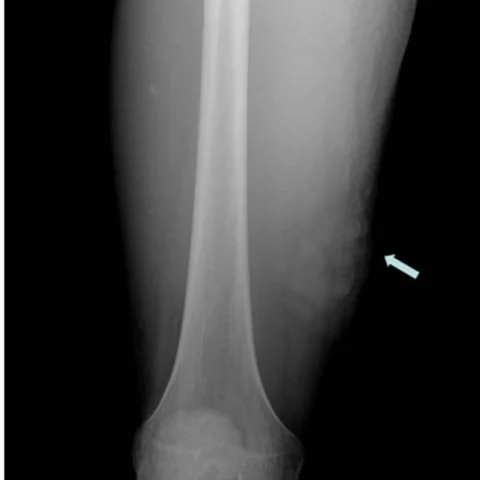
Patient history
A 22-year-old HIV-positive man was admitted with pneumonia; CT of the chest showed non-specific findings. Physical examination revealed a lobulated mass on the posteromedial aspect of the right thigh. The patient reported progressive growth over several months.
Imaging findings — key points
- The radiograph of the right thigh shows a non-specific soft-tissue prominence without calcification or bone abnormality.
- MRI demonstrates a lobulated mass involving the skin, subcutaneous fat and underlying muscle of the posteromedial thigh, with intermediate signal on T1-weighted images and hyperintensity on T2-weighted images.
- The mass enhances avidly and heterogeneously after gadolinium, with involvement of the fascial planes and no discrete capsule.
- CT shows a corresponding enhancing soft-tissue mass without bone destruction or calcification.
- Colour Doppler ultrasound demonstrates increased vascularity within the lesion.
Discussion
Kaposi sarcoma is a vascular tumour associated with human herpesvirus 8 that occurs in immunocompromised patients, particularly those with advanced HIV, and it may involve the skin, mucosa, lymph nodes and viscera. On imaging it produces a lobulated, hypervascular soft-tissue mass with skin and fascial involvement, and the diagnosis is confirmed by biopsy showing spindle cells and slit-like vascular spaces. The main differential is bacillary angiomatosis, which is caused by Bartonella species and also occurs in HIV, but it responds to antibiotics and has different histology. Treatment depends on the extent of disease and includes antiretroviral therapy, local therapy and systemic chemotherapy.
Differential diagnosis
| Alternative diagnosis | Key features that distinguish it from this case |
|---|---|
| Bacillary angiomatosis | Bacillary angiomatosis occurs in HIV patients and produces similar vascular lesions, but it responds rapidly to antibiotics and is not associated with the mucocutaneous distribution of Kaposi sarcoma. |
| Lymphoma | Lymphoma produces a bulky, homogeneous mass with restricted diffusion and less avid enhancement, without the vascular, skin-based and fascial involvement seen here. |
| Angiosarcoma | Angiosarcoma is more aggressive, with ill-defined margins, haemorrhage and necrosis, and it does not typically occur as a multifocal skin and muscle lesion in an HIV-positive young man. |
| Intramuscular haematoma | A haematoma shows blood signal and a history of trauma, does not enhance internally and resolves on follow-up imaging. |
The confirmed diagnosis itself is not included as an alternative — it is stated separately below.