Eagle syndrome
Written and reviewed by RadLearn editorial team · Updated 20 Oct 2026
Figures (7)
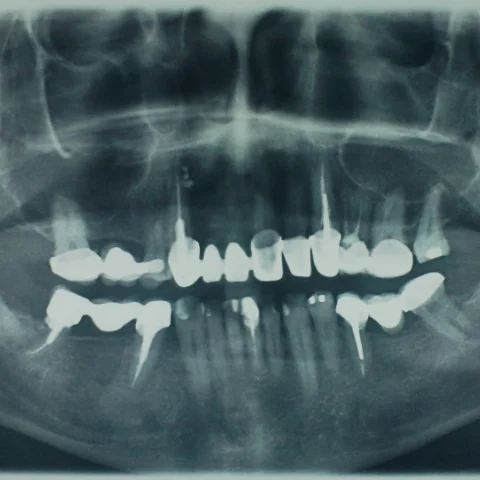
Patient history
The patient presented to the dentist with recurrent oropharyngeal and facial pain, particularly on chewing on the right side. After examining the teeth, an orthopantomogram (OPT) was requested. Based on the findings, the patient went on to have CT of the cervical spine.
Imaging findings — key points
- The orthopantomogram and cervical CT show bilateral elongation of the styloid processes, measuring more than 30 mm, with the right side longer and directed anteromedially.
- The stylohyoid ligaments are partially ossified, and the elongated process approaches the tonsillar fossa and the course of the glossopharyngeal nerve.
- Axial and coronal CT reformats confirm the relationship of the styloid process to the internal carotid artery, which lies posterolateral to its tip.
- 3D volume-rendered reformats display the full length and orientation of the stylohyoid complex and exclude fracture or dislocation.
- No bone destruction, soft-tissue mass or cervical lymphadenopathy is present.
Discussion
Eagle syndrome refers to symptoms caused by an elongated styloid process or ossified stylohyoid ligament compressing the glossopharyngeal nerve or the internal carotid artery, and it typically presents with recurrent throat pain, dysphagia, foreign-body sensation or facial pain on chewing and head rotation. The normal styloid process measures about 25 mm, and elongation beyond 30 mm with anteromedial deviation is considered significant. CT with 3D reformats is the best way to measure the process and demonstrate its relationship to the tonsillar fossa and carotid artery, and it also excludes other causes of cervicofacial pain. Treatment ranges from conservative analgesia and local injection to surgical shortening of the styloid process in refractory cases.
Differential diagnosis
| Alternative diagnosis | Key features that distinguish it from this case |
|---|---|
| Trigeminal neuralgia | Trigeminal neuralgia produces paroxysmal electric-shock pain in a trigeminal distribution without a mechanical trigger on neck rotation or swallowing, and imaging shows a normal styloid process. |
| Temporomandibular joint disorder | Temporomandibular joint disorder causes pain and clicking localised to the joint with restricted opening, and the styloid process is of normal length. |
| Glossopharyngeal neuralgia | Glossopharyngeal neuralgia produces severe throat pain triggered by swallowing but is not associated with an elongated styloid process or compression of adjacent structures. |
| Otitis media | Otitis media causes ear pain, discharge and hearing loss with inflammatory changes in the middle ear on imaging, without styloid elongation. |
The confirmed diagnosis itself is not included as an alternative — it is stated separately below.